
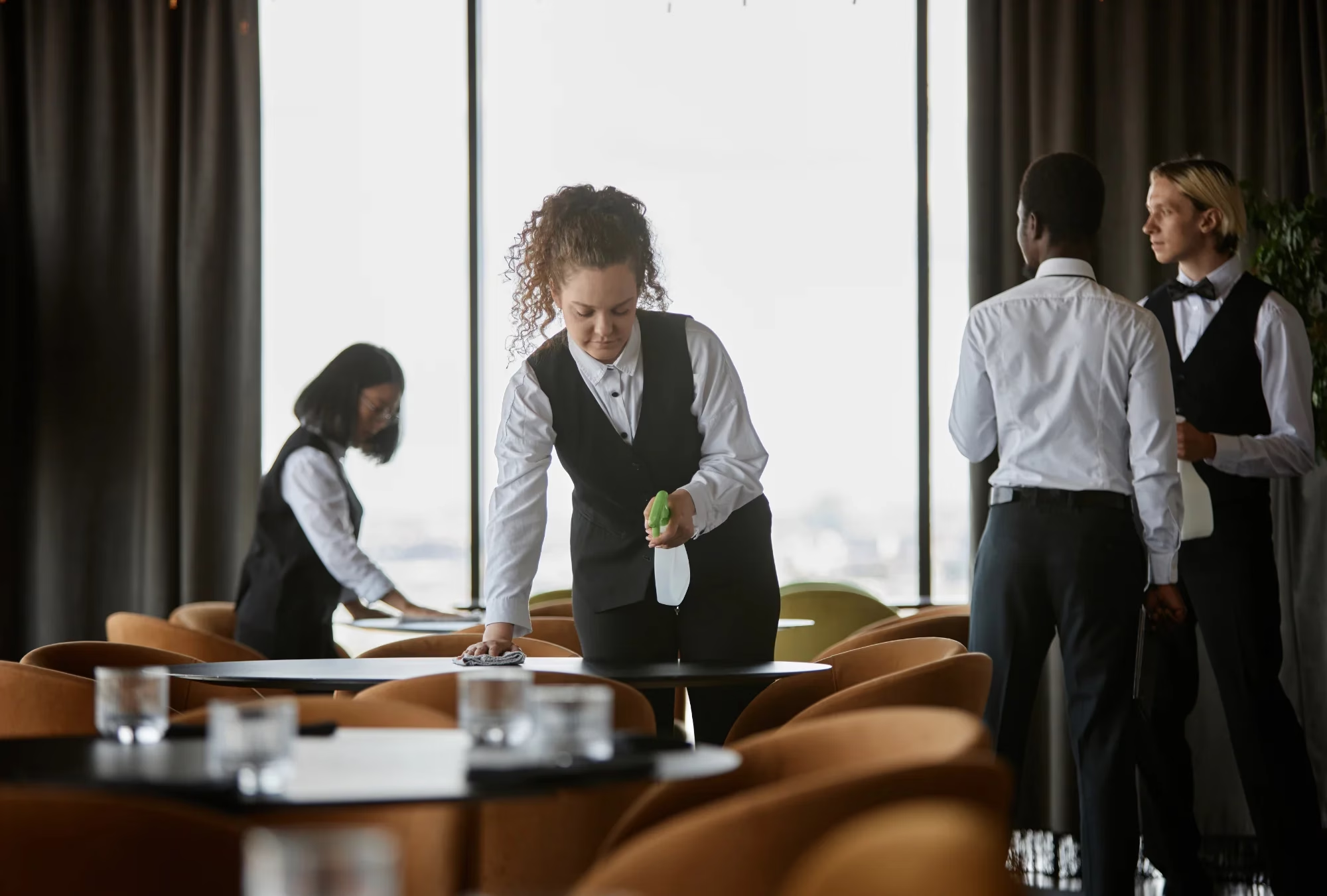
Major waterfront celebrations do not fail in the boardroom. They fail on the floor, in the service lines, and at the guest interaction points where a plan that looked solid on paper encounters the reality of thousands of people moving through piers, docks, and shoreline venues at the same time.
The logistics of large-scale event staffing are more complex than any other event category. You are not managing one service environment. You are managing multiple zones, multiple guest profiles, multiple service windows, and an operational timeline that begins days before the event and does not end until the last table is cleared and the last credential is collected.
This guide walks through every phase of staffing a large-scale waterfront activation, from pre-event planning through the closing celebration, with the roles, decisions, and partnership questions that determine whether your event is remembered for the experience or the gaps in it.
Table of Contents
- What Is a Waterfront Activation and Why Does Staffing Make or Break It?
- Phase 1: Pre-Event Staffing Planning for Large-Scale Waterfront Events
- Phase 2: Day-Of Operations and Large-Scale Event Staffing in Action
- Phase 3: Closing Celebrations and Post-Event Breakdown
- What Roles Does a Large-Scale Waterfront Activation Actually Need?
- How to Choose a Staffing Partner for Large-Scale Waterfront Events
- America 250 and Sail4th: What Large-Scale Hospitality Staffing Looks Like at a National Level
What Is a Waterfront Activation and Why Does Staffing Make or Break It?
A waterfront activation is not a passive venue experience. It is a branded hospitality environment designed to create a specific impression: on guests, on sponsors, on partners, and on the dignitaries and officials moving through the space.
The difference between a venue and an activation is intentionality. A venue provides space. An activation provides an experience, and that experience is delivered almost entirely by the people working in it.
The Difference Between a Passive Venue and an Active Brand Experience
At a standard venue, guests find their seats, locate the concessions, and manage their own experience. At a branded waterfront activation, the hospitality team is the experience. Every guest interaction, from arrival check-in to suite service to post-event reception, is a touchpoint that either reinforces or undermines the investment the brand has made in the event.
Sports Business Journal research on sponsor hospitality consistently shows that the quality of the on-site guest experience is the primary driver of sponsor ROI satisfaction. The venue, the program, and the celebration itself are given. What differentiates a successful activation from an expensive one is the human layer.
What Guests, Sponsors, and Organizers Each Need From Your Staff
Guests need to feel welcomed, attended to, and able to move through the event without friction. Sponsors need their hospitality investment to reflect well on their brand and their business relationships. Organizers need staff who can execute independently, escalate appropriately, and adapt to conditions that will not match the pre-event plan exactly.
These are not competing needs. They are addressed by the same thing: professional event staffing with the training and operational infrastructure to serve all three audiences simultaneously.
Phase 1: Pre-Event Staffing Planning for Large-Scale Waterfront Events
Pre-event planning is where large-scale event staffing either gets built correctly or inherits the problems that will surface later. The decisions made in this phase determine how much flexibility your team has when conditions change on event day.
How to Calculate Staffing Needs by Zone and Function
Large waterfront activations are multi-zone environments. Each zone has its own guest volume, service format, and staffing requirements. A VIP hospitality suite has different demands than a general public viewing area, which has different demands than a sponsor lounge, which has different demands than a registration and credentialing desk.
Effective pre-event planning maps every zone independently. For each zone, you need to know the expected guest count at peak, the service format, the physical dimensions of the space, the duration of the service window, and the distance from supply points. From those inputs, you build a zone-specific staffing model rather than applying a single ratio across a diverse venue.
The Event Safety Alliance recommends zone-by-zone operational planning for large events as a baseline safety and service standard. The same logic that applies to crowd safety applies to service quality: generic planning for diverse environments produces generic, insufficient results.
Add a 10 to 15 percent buffer across your total count. At the scale of a large waterfront activation, a no-show is not an inconvenience. It is a zone under-coverage problem with immediate guest-facing consequences.
Briefing vs. Training: What Your Team Actually Needs Before They Arrive
A briefing tells your staff what is happening at this specific event. Training prepares them for what to do when the event deviates from the briefing, which it always does.
At large-scale events, the conditions that staff encounter on day one are never exactly what was described in the pre-event briefing. Timelines shift. Zones get reconfigured. Guest counts exceed projections in one area and fall short in another. Staff who have been trained in front-of-house service protocols, event operations, and guest management adapt to these conditions in real time. Staff who have only been briefed for this event are lost the moment the plan changes.
This is precisely why the outsourced event staffing model works best when the agency has a genuine training infrastructure, not just an availability roster.
Coordinating Credentials, Uniforms, and Arrival Logistics
Large waterfront events operate within credentialing and access control systems that have no equivalent in standard corporate event planning. Every staff member needs the correct credentials for every zone they are assigned to. Credential processing takes time, requires specific documentation, and is managed by venue, city, and event security teams who are not flexible on compliance.
Pre-event coordination with the venue’s and city’s operations teams must begin well in advance: often four to six weeks before the event for major activations. Uniform specifications, arrival windows, staff staging areas, and communication protocols all require confirmation before event day. Agencies that have not navigated these logistics before will encounter them as obstacles. Agencies with large-venue experience treat them as standard operating procedure.
Phase 2: Day-Of Operations and Large-Scale Event Staffing in Action
Pre-event planning determines your ceiling. Day-of operations determine whether you reach it.
Managing Multiple Service Zones Simultaneously
On event day, a large-scale waterfront activation is a collection of simultaneous service environments, each with its own pace, its own guest dynamics, and its own staffing demands. The operational challenge is maintaining visibility and control across all of them at once.
This is where the captain’s structure becomes the difference between a coordinated operation and a fragmented one. Catering captains serve as the operational layer between zone-level staff and event management. Each captain owns their zone: they monitor service quality, manage pace, handle guest escalations, and communicate upward when something requires management attention.
Without zone-level captains, management receives information too late to act on it. With a strong captain structure, problems are identified and addressed before they become guest-facing failures.
Real-Time Communication Between Captains, Managers, and Agency Contacts
At a large waterfront activation, the communication chain is as important as the staffing model. Before the event starts, every person in that chain should know exactly who they report to, how to reach them, and what kinds of decisions they are authorized to make independently.
Zone captains communicate with an event captain or floor director. The event captain communicates with the client contact and the agency contact. The agency contact has the authority and the resources to respond to staffing adjustments in real time.
When this chain is clear, and everyone in it is empowered to act within their scope, the operation absorbs change without breaking. When it is ambiguous, information travels too slowly and decisions happen too late.
Handling Surges, Delays, and Last-Minute Changes on the Floor
High-volume waterfront events produce surges. A fireworks display or tall ships procession compresses guest demand from an extended period into a tight viewing window. A delayed schedule moves the entire service timeline and creates a gap that your staffing model was not designed for. A VIP arrival requires immediate resource reallocation away from general hospitality.
Experienced large-scale event staffing teams anticipate these scenarios before they happen. They pre-position resources for surge periods, define escalation paths for timeline changes, and maintain enough operational slack to redirect staff between zones without leaving any zone critically understaffed.
This kind of responsiveness is not improvised on the day. It is designed into the staffing plan in advance by an agency and a client team who have both thought through what the event will actually look like under pressure.
Phase 3: Closing Celebrations and Post-Event Breakdown
The end of a large waterfront activation is not the end of the event. It is the last impression your guests carry away from the experience, and it deserves the same operational attention as the opening.
Staffing the Final Push: Receptions and VIP Closings
Closing receptions and VIP wind-down experiences often run with reduced staff as the broader team begins breakdown activities. The temptation to pull resources from the closing reception to accelerate venue breakdown is understandable but costly.
Guests at a closing reception are in a reflective state. They are making their final assessment of the experience. Reduced or inattentive service at this stage leaves a disproportionately negative impression relative to any operational efficiency gained by pulling staff early.
The right approach is to stage the breakdown activity so that the closing reception maintains full coverage until the last guest exits. Breakdown work begins in the zones that are already finished, not in the spaces where guests are still being served.
Breakdown Logistics and What a Professional Team Handles vs. What They Don’t
A professional hospitality staffing solutions partner defines in advance exactly what their staff is responsible for during a breakdown and what falls outside their scope. This prevents two common problems: scope creep, where event staff are asked to perform venue work outside their role, and coverage gaps, where staff begins breakdown in areas that are still in service.
Clarity on breakdown responsibilities is a pre-event conversation, not an event-day negotiation.
What Roles Does a Large-Scale Waterfront Activation Actually Need?
The staffing model for a large waterfront activation is more complex than that of a single-format event. The roles required span multiple functions, and their proportions shift based on the specific activation design.
Front-of-House: Servers, Bartenders, Concierge, and Coat Check
Servers and professional event bartenders form the visible front line of the hospitality operation. At a large waterfront activation, they need the technical skills to execute their roles efficiently across an extended, high-volume service window, and the composure to maintain service quality when conditions get demanding.
In VIP and suite environments within the activation, concierge-level guest services staff provide a dedicated point of contact for high-priority guests. Coat check staff at cooler-weather or indoor portions of the event handle a logistical function that is more visible than it sounds: a long coat check line or a missing item creates a disproportionate guest experience failure relative to any other breakdown.
Guest Services and Registration
Registration and guest services staff are the first human contact guests have with the activation. Their efficiency, warmth, and product knowledge set the tone for everything that follows. At large-scale events, registration needs to be fast: long queues at entry create frustration that colors the guest’s perception of the entire experience before they have reached the first hospitality zone.
Captains as the Operational Backbone
In any large-scale event staffing model, captains are the element that makes everything else function. They are the translators between management intent and floor execution, the first responders when service conditions change, and the quality control layer that keeps standards consistent across a multi-zone, multi-hour operation.
The ratio of captains to staff at a large activation should be higher than at a standard event. The complexity of the environment justifies the investment.
How to Choose a Staffing Partner for Large-Scale Waterfront Events
Not every staffing agency has the operational infrastructure to support a large-scale waterfront activation. The questions you ask before signing a contract will tell you quickly which category your candidate agency falls into.
Why Experience at Scale Is Different From Experience at Standard Events
An agency that excels at corporate dinners for 50 guests may not have the multi-zone coordination capability, the captain infrastructure, the credentialing experience, or the same-day flexibility that a large waterfront activation requires. Scale is not just a quantity difference. It is a qualitative operational difference.
Ask specifically about events the agency has staffed at a comparable scale. Ask about the venue types, the staff counts, the supervision structures, and the specific challenges they encountered and how they resolved them.
What to Ask Before Signing a Contract
Before committing to a large-scale event staffing partner, confirm:
What is your process for same-day staff changes at this scale? How do you structure your captain and floor supervision model for multi-zone events? Have you coordinated with venue and city operations teams for large-venue credentialing and logistics? Do you cover payroll, taxes, and liability for all placed staff? What is your minimum advance notice requirement for events of this size?
Red Flags That Signal a Placement Agency, Not a True Partner
An agency that cannot answer the supervision structure question specifically, that has no documented process for same-day changes, or that does not cover payroll and liability, is a placement service operating at large-event scale. That distinction matters: a placement service gives you a roster. A true partner gives you an operation.
America 250 and Sail4th: What Large-Scale Hospitality Staffing Looks Like at a National Level
America’s 250th anniversary and the Sail4th tall ships celebration represent one of the largest hospitality staffing challenges in recent memory on the East Coast. With waterfront programming spread across multiple piers and venues, a national audience, and the full infrastructure of a multi-day commemorative celebration, the staffing demands extend far beyond what any single local event generates.
Scale, Geography, and the Staffing Demands of a Multi-Day Commemoration
According to PwC’s industry outlook on major civic and cultural events, celebrations at this scale generate substantial economic activity, with hospitality and brand activation representing one of the highest-margin components of sponsor and partner investment. That investment requires a staffing infrastructure capable of operating consistently across multiple zones and multiple days simultaneously.
Venues, hotels, sponsor lounges, public viewing areas, and VIP hospitality spaces across the harbor and waterfront need trained, coordinated front-of-house teams. The challenge is not just finding enough people. It is finding enough trained, vetted, operationally ready people who can represent a brand standard at a national, high-visibility level.
The convention and festival staffing demands of a commemoration like this are unlike standard domestic corporate events. Staff need to be prepared for diverse guest interactions, weather-variable outdoor conditions, extended service windows across multiple event days, and the operational complexity of working within a city’s and venue’s event management framework.
How HMG+ Is Preparing to Staff America’s Biggest Birthday Celebration
HMG+ is already preparing to staff America 250 and Sail4th, deploying vetted, trained, and safety-certified hospitality professionals across New York Harbor’s waterfront celebrations. With more than 30 years of front-of-house staffing experience and a training model that prepares staff for elevated service environments rather than simply placing them, HMG+ is positioned to support venues, sponsors, and brands across the full scope of this historic commemoration.
For organizations planning hospitality activations around America’s 250th anniversary, the window to secure staffing partnerships is narrowing. Events at this scale require pre-event coordination that begins months before the tall ships arrive.
Large-scale waterfront activations reward preparation and punish improvisation. Every phase of the event, from pre-event planning through the closing celebration, performs better when the staffing plan is built with operational precision rather than assembled under pressure.
If you are planning a major waterfront activation and need a staffing partner with the infrastructure to deliver at scale, request a staffing quote from HMG+ and let us build a plan designed for what your event actually requires.
Frequently Asked Questions
What is large-scale event staffing?
Large-scale event staffing refers to the coordinated deployment of trained front-of-house hospitality professionals across a multi-zone, high-volume event environment. It includes roles such as servers, bartenders, catering captains, guest services staff, and registration personnel, organized under a supervisory structure designed to maintain service quality across the full duration of the event.
How far in advance should I book staffing for a major waterfront celebration?
For large-scale waterfront events, booking four to eight weeks in advance is a minimum. For national, multi-day commemorations like America 250 and Sail4th, pre-event coordination should begin three to six months before the event to allow time for credentialing, logistics planning, and staff allocation across multiple zones.
What is the difference between festival staffing and corporate event staffing?
Festival staffing typically involves outdoor, multi-day events with high guest volume, diverse service zones, and a broader range of roles, including general hospitality and crowd-facing positions. Corporate event staffing focuses on professional environments where brand alignment, guest relationship management, and service precision are primary priorities. Large waterfront activations often require elements of both.
How many staff do I need for a large waterfront activation?
The right count depends on the number of service zones, the guest volume by zone, the service format in each zone, and the duration of the service window. A general planning benchmark is one server per 20 to 25 guests in a reception format, one per 15 to 20 guests for plated or suite service, and a captain per 6 to 8 floor staff. Add a 10-15% buffer across all zones.
Can outsourced event staffing work across multiple zones simultaneously?
Yes, for agencies with the operational infrastructure to support multi-zone deployment. This requires a training model that produces consistent performance standards regardless of location, establishes relationships with venue and city operations teams, and has a coordination structure capable of managing multiple zones concurrently. Confirm these capabilities explicitly before engaging an agency for a multi-zone activation.
