
Luxury suite guests do not judge an event by the view. They judge it by the quality of service the moment they walk in. Whether it is a corporate hospitality box at a major championship or a branded suite at an international summit, guests at this level arrive with expectations that are difficult to meet and very easy to fall short of.
One understaffed suite can undo months of planning. One undertrained server can leave a VIP guest with a lasting impression that has nothing to do with the event itself. Luxury suite staffing is not a line item to optimize for cost. It is a precision operation that determines whether your guests feel valued or forgotten.
This post breaks down exactly what luxury suite staffing requires: the roles, the service standards, the questions worth asking before you hire anyone, and how to find a partner with the experience and training infrastructure to deliver consistently at this level.
Table of Contents
- What Makes Luxury Suite Staffing Different From Standard Event Staffing
- Key Roles in a Luxury Suite Staffing Team
- What Does Luxury Suite Staffing Actually Cost?
- How to Staff a Suite for International Sporting Events
- Corporate Suite Hospitality: Different Stakes, Same Standards
- What Should You Ask a Luxury Suite Staffing Agency Before You Hire Them?
- How HMG+ Approaches Luxury Suite Staffing
What Makes Luxury Suite Staffing Different From Standard Event Staffing
Most event staffing assignments require competence. Luxury suite staffing requires something more: a calibrated sense of presence, anticipation, and discretion that generalist staff rarely develop without intentional training.
The difference is not just about polish. It is about how your team reads a room and responds to it before a guest has to ask for anything.
The Service Standards Guests Expect in a Suite Environment
Suite guests are accustomed to elevated hospitality. They expect staff who move efficiently without disrupting conversation, who maintain eye contact without being intrusive, and who can communicate confidently with guests ranging from corporate executives to celebrity athletes to international dignitaries.
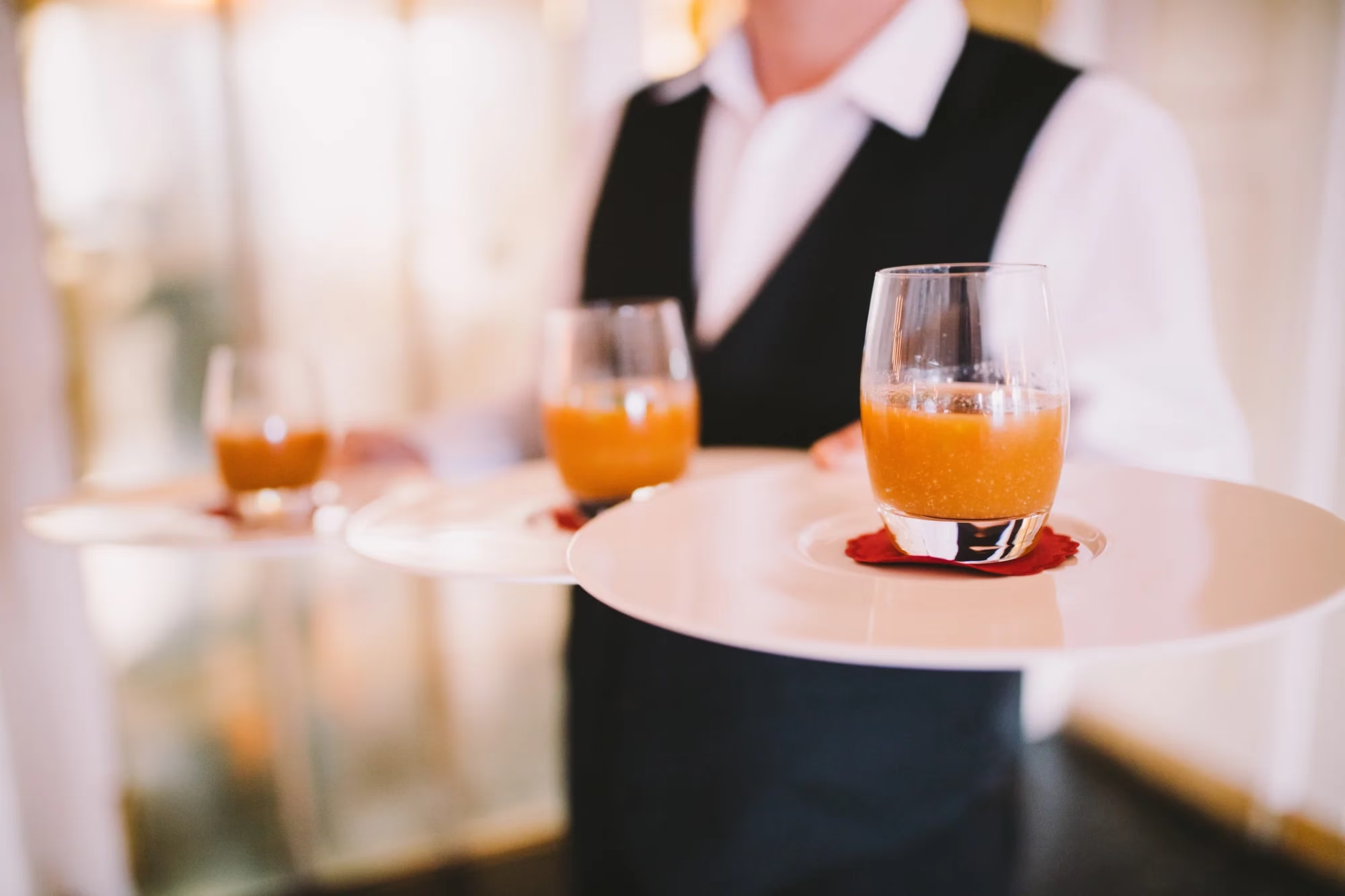
Presentation matters at every touchpoint: uniform precision, tray technique, the way a drink is placed, and a course is cleared. These are not incidental details. For guests at this level, they are the entire experience.
Research from the Cornell Center for Hospitality Research consistently shows that service quality, not food or amenities, is the primary driver of guest satisfaction at premium events. When service falls short, no amount of premium catering or venue prestige compensates.
Why Generalist Staff Rarely Cut It at This Level
A server who performs well at a standard corporate lunch may not have the pacing, composure, or product knowledge required in a luxury suite environment. Suite service often runs for extended periods with shifting guest dynamics, tight physical spaces, and rapid course transitions. Without specific training in fine dining protocol and VIP guest management, staff default to behaviors that work at lower-stakes events but read as awkward or inattentive in a suite.
This is why professional event staffing for luxury environments requires more than availability. It requires staff who have been trained specifically for elevated front-of-house service and tested in comparable settings.
Key Roles in a Luxury Suite Staffing Team
Luxury suite staffing is not a one-role operation. The composition of your team depends on the suite size, the type of event, the guest count, and the service style. But most successful suite staffing configurations share a consistent set of core roles.
Captains and Floor Leads
Trained catering captains are the operational backbone of any luxury suite setup. A captain manages the flow of service, coordinates between staff members, communicates with the venue and client contacts, and handles anything that deviates from the plan. In a suite environment, the captain is also the first line of quality control.
Without a strong captain, even a talented team of servers and bartenders operates without a rudder. The captain is what makes the difference between a team that responds to problems and a team that prevents them.
Servers, Bartenders, and Concierge-Level Guest Services
Experienced event bartenders in a luxury suite context are expected to execute craft cocktails, manage speed during peak demand, and interact with guests at a level that feels personal rather than transactional. Servers need the same combination of technical skill and social intelligence.
In some suite configurations, a dedicated concierge-level guest services role is warranted: someone whose sole responsibility is anticipating guest needs, managing requests, and acting as the primary point of contact for VIPs.
How Team Composition Shifts by Event Type and Guest Count
A 20-person corporate hospitality suite at a conference may require two servers, one bartender, and a captain. A 60-person branded suite at an international sporting event may require four servers, two bartenders, a captain, and a dedicated guest services liaison.
The right agency partner calculates these ratios based on the specific event profile rather than applying a generic formula. Undercounting by even one or two staff members at the suite level creates service gaps that are immediately visible to guests.
What Does Luxury Suite Staffing Actually Cost?
The honest answer is that luxury suite staffing costs more than standard event staffing, and for good reason.
Staffing at this level draws on trained professionals with verifiable experience in fine dining and VIP service environments. It requires a supervisory structure, not just bodies filling roles. And it involves a staffing partner who carries the payroll, tax, and liability burden, removing significant legal and administrative risk from your organization.
Factors That Influence Pricing
Several variables shape the final cost of luxury suite staffing.
- Number of staff and roles required
- Duration of the event and service window
- Whether the staffing agency handles payroll and liability coverage
- The level of pre-event training and briefing involved
- Market rates in the event’s host city
At HMG+, staffing is priced based upon request. Our rate reflects trained, vetted, safety-certified professionals whose payroll, taxes, and liability are fully covered. For clients evaluating total event cost, that coverage represents significant risk reduction that a lower hourly rate from a less structured agency does not provide.
Why the Cheapest Option Almost Always Costs More in the End
The economics of understaffed or undertrained luxury service are unforgiving. A single guest complaint at a corporate hospitality event can affect business relationships that took years to build. A visible service failure in a branded suite tied to an international sporting event reflects on the sponsor, not just the venue.
The cost of a hospitality failure at this level: lost client trust, damaged brand perception, and the very real possibility that the relationship that justified the suite investment does not survive the event.
Investing in quality VIP event staff is not a luxury. It is the only rational calculation when the stakes are high enough to warrant a suite in the first place.
How to Staff a Suite for International Sporting Events
International sporting events create staffing conditions that have no equivalent in standard corporate event planning. The scale, the compressed timelines, the credential requirements, and the velocity of service during peak demand all require a level of operational preparation that most agencies are not equipped to provide.
Volume, Velocity, and Timing Pressures Unique to Large Sports Activations
A suite at a major championship game may turn over guests multiple times across a single event day. Service windows can be short and intense. Guests arrive expecting immediate hospitality, not a staged rollout.
For Soccer Event staffing and events of similar scale, the staffing challenge extends beyond a single suite. Host cities require coordinated deployment of trained hospitality professionals across multiple venues, hospitality clubs, and brand activations simultaneously.
The International Association of Venue Managers recommends detailed pre-event operational planning for large-venue staffing, including defined staff-to-guest ratios by zone, credentialing protocols, and real-time communication structures. These recommendations exist because improvisational staffing at this scale consistently fails.
Coordinating With Venue Operations and Security Protocols
Large sporting events operate within complex logistical frameworks. Your staffing partner needs experience navigating venue access requirements, credential clearance processes, union considerations where applicable, and coordination with venue operations teams.
Staff who have never worked in a large sports venue context often struggle with the physical logistics alone: where to position, how to move, how to replenish without disrupting crowd flow. These are learned behaviors, not instincts.
Corporate Suite Hospitality: Different Stakes, Same Standards
Corporate suite hospitality at conferences, trade events, and partner entertainment events carries a different set of stakes than a sporting event, but the service standards are the same.
Branding Alignment and Client-Facing Professionalism
In a corporate context, your suite staff is representing your brand to the clients and partners sitting across from you. How they carry themselves, how they speak, how they handle an unexpected request: all of it reflects on your organization.
Corporate event staffing at the suite level requires staff who understand professional context. They need to know when to be present and when to recede, how to handle conversations with senior executives, and how to maintain consistency across a long event day without visible fatigue.
Managing VIP Guests in a Corporate Context
Corporate suites often include a mix of guest profiles: executives, clients, partners, and in some cases, media or government contacts. Managing hospitality across that range requires social intelligence that goes beyond serving technique.
Staff need to treat every guest with the same attentiveness regardless of their role in the room. In practice, this means no preferential positioning that leaves some guests waiting, no visible differentiation in service quality, and no conversations that breach professional discretion.
What Should You Ask a Luxury Suite Staffing Agency Before You Hire Them?
The staffing industry has a significant range in quality. Many agencies operate as placement services: they match warm bodies to open roles and move on. A genuine luxury suite staffing partner operates differently. The right questions reveal which kind of agency you are actually talking to.
Vetting Questions That Separate Reliable Partners From Placement-Only Agencies
Ask directly:
- Do you train your staff, or do you place them and expect the client to brief them on-site?
- How do you handle no-shows or last-minute staff changes on event day?
- Can you describe a high-volume event you have staffed at this level and what the challenges were?
- What does your captain’s structure look like for a suite of our size?
- Are your staff vetted and safety-certified, and can you document that?
An agency that has real answers to these questions, specific, operational, and grounded in actual experience, is a fundamentally different partner than one that responds with marketing language.
Why Training, Vetting, and Payroll Coverage Matter
The outsourced event staffing model works best when the agency carries the operational infrastructure: training programs, vetting processes, payroll, taxes, and liability. When those elements sit with the client rather than the agency, the cost and risk of a staffing failure fall on you.
An agency that covers payroll and liability removes a meaningful administrative and legal burden. More importantly, it signals that the agency is genuinely invested in the quality of the staff they place, because they carry the consequences if something goes wrong.
How HMG+ Approaches Luxury Suite Staffing
HMG+ has spent more than 30 years building a staffing model specifically designed for the demands of elevated front-of-house service. That means something different than most agencies.
Every HMG+ staff member is trained, not just placed. They go through a vetting process before they are ever assigned to a client event. They are safety-certified. And when they arrive at your suite, they are briefed on the specific event, the client expectations, and the service standards required.
HMG+ covers payroll, taxes, and liability on every engagement. Clients do not inherit the administrative complexity of managing a temporary workforce. They receive a professional team that shows up, executes at a high level, and reflects the standard their guests expect.
After 30 years of placing staff at luxury events across New York and Chicago, HMG+ has developed a clear picture of what suite-level service actually requires. That institutional knowledge is what clients are buying when they choose a partner who trains rather than places.
If you are planning a high-profile event and need a front-of-house team that can deliver at the suite level, the conversation starts with a quote.
Request a staffing quote at HMG+ and let us build the right team for your event.
Frequently Asked Questions
What is luxury suite staffing?
Luxury suite staffing refers to the placement of trained, experienced front-of-house professionals in premium suite environments at sporting events, corporate hospitality functions, and high-profile activations. It includes roles such as servers, bartenders, catering captains, and concierge-level guest services staff who are prepared to deliver elevated, anticipatory service to VIP guests.
How many staff do I need for a luxury suite?
The right staffing ratio depends on your guest count, the length of the service window, and the type of event. A general benchmark for luxury suite environments is one server per eight to ten guests, plus a dedicated captain and at least one bartender for suites with bar service. A professional luxury suite staffing agency can build a more precise plan based on your specific event profile.
What makes a luxury event staffing agency different from a general staffing agency?
A luxury event staffing agency trains its staff for elevated front-of-house service rather than simply placing available workers. They vet staff before placing them, provide a supervisory structure on-site, cover payroll and liability, and have demonstrated experience in high-stakes event environments. A general staffing agency may fill your roster but cannot guarantee the service standards a luxury suite requires.
How far in advance should I book luxury suite staffing?
For major sporting events and international activations, booking four to eight weeks in advance is recommended. High-demand periods, particularly around large-scale events like championship tournaments or corporate conference seasons, can limit availability for trained VIP event staff if the request comes too late.
Can a hospitality staffing agency in NYC provide staff for out-of-market events?
HMG+ staffs events across the tri-state area and Chicago. If your event falls within those markets, we can deploy trained, vetted front-of-house professionals with the full support of our operational infrastructure. For events outside those regions, we recommend sourcing a local agency with established roots in that market.